Straw vs. wood shavings
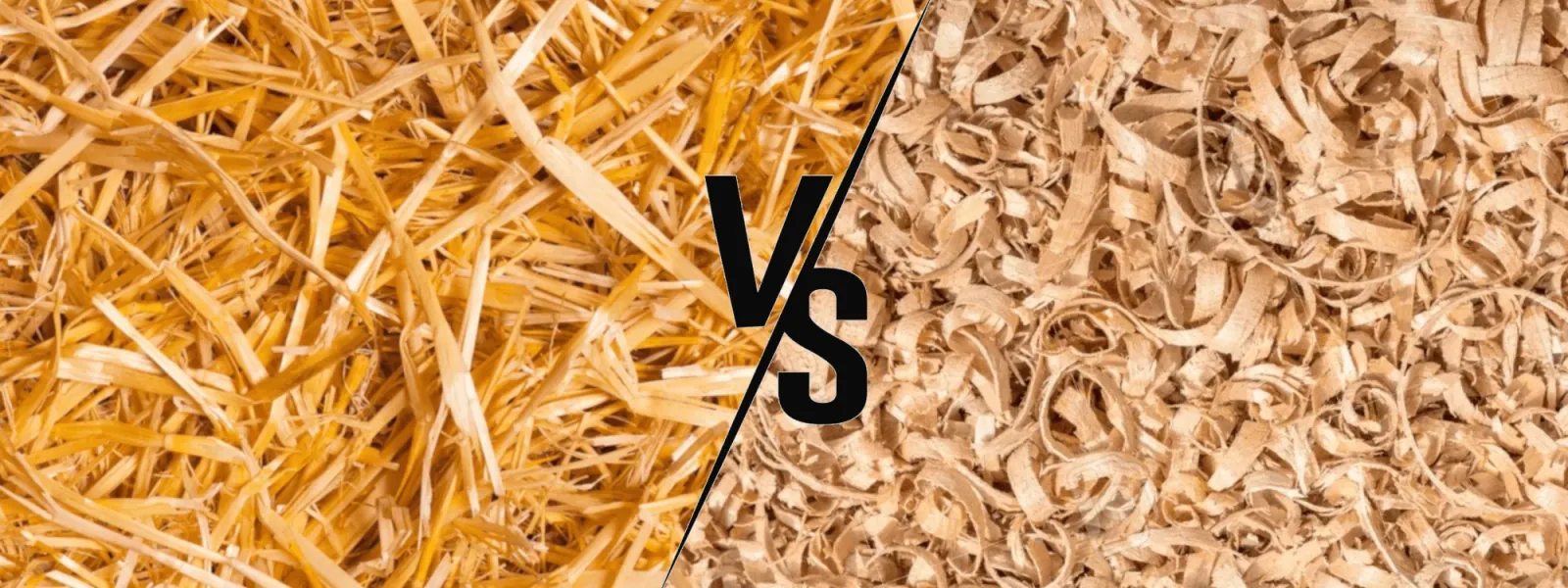
Time and again we talk to farmers who currently use planer shavings as bedding and are toying with the idea of switching to (chopped) straw. In this article you'll find out where the advantages and disadvantages of the two bedding options lie.
Absorbency
As a tendency, planer shavings can absorb more moisture than traditional straw. Planer shavings also bind odours better. So if you compare normal straw with planer shavings, this point clearly goes to the wood product. BUT: besides classic straw, there is also chopped straw on the market, which – similar to planer shavings – thanks to a frayed structure can absorb significantly more liquid than long-stalk straw. Chopped straw can thus often even bind more moisture than planer shavings can. Chopped straw also binds odours significantly better than traditional straw.
The bedding process
Measured by weight, with long straw significantly less has to be spread in the first step than with planer shavings. Spread over the year, however, you have to top up significantly more often and in larger amounts – compared with the competing bedding, more manure is produced per year. With planer shavings it is the other way round: the first time significantly more kilograms are needed, but topping up is less frequent and smaller, which over the year means lower consumption and less manure. Chopped straw behaves very similarly to planer shavings here.
Disposal
Whether long-stalk or chopped: straw is natural and rots quickly, so composted straw manure is a very popular fertiliser among farmers – chopped straw especially because it composts even faster. Planer shavings, on the other hand, compost only very slowly, often cause soil acidification and are also not suitable for biogas plants.
The costs
The best bedding is of little use if it isn't affordable. A clear statement about which is cheaper unfortunately can't be made here: normal straw is usually cheaper than chopped straw or planer shavings, but also needs a larger bedding quantity. In the end it depends above all on where you buy – whoever gets straw cheaply (say from a neighbour or from their own farm) often comes off cheapest. But it should be kept in mind: spreading normal, long straw is significantly more laborious than with chopped straw or planer shavings.
The conclusion
Basically everyone has to decide for themselves which bedding is best for them. Of course, special conditions in the stable also play an important role here. We, for our part, (of course) have a favourite – and that is (… surprise …) chopped, dedusted straw from Manz-Stroh.